Why Alfalfa Production Increasingly Depends on Mechanization
Growing demand and the need for efficiency
In recent years, international markets like Southeast Asia, the Middle East, and Europe have shown steady demand for high-quality alfalfa. This growing demand forces producers to optimize their operations. In this context, the lack of modern machinery in alfalfa production becomes a critical bottleneck.
It’s not just about how much manual labor is required. Alfalfa is a high-maintenance crop with frequent cutting cycles. Without the right equipment for mowing, windrowing, drying, and baling, production time doubles—and so do losses.
Impact on production costs
When processes are not mechanized, production costs rise significantly. Renting outdated machinery, constant breakdowns, and reliance on skilled operators lead to major delays. Moreover, if harvesting isn’t done at the right moisture point, the nutritional quality of alfalfa suffers.
This doesn’t just hurt profit margins—it damages competitiveness. Buyers compare crude protein, Relative Feed Value (RFV), and moisture levels. A single mechanical error can lead to load rejection.
Key Machinery for Optimizing Alfalfa Cultivation
Mowers and conditioner cutters
One of the most critical steps is cutting. Most producers lacking modern alfalfa equipment either rent or use outdated machines, delaying the harvest. Newer conditioner mowers cut uniformly and accelerate drying, which improves forage quality.
These machines also help preserve leaves, where most of the protein is stored. Proper cutting with the right equipment can increase nutritional value by up to 15%—a difference worth thousands of dollars per harvest.
Rakes and tedders
After cutting, raking is key. Without proper windrowing, drying happens unevenly, resulting in alfalfa bales with variable moisture, which can lead to mold, fermentation, or even fires in storage.
Modern rakes form uniform rows while minimizing leaf loss. Tedders help distribute the crop evenly during humid conditions or after rain, ensuring consistent drying.
Direct Consequences of Operating with Outdated Equipment
Lower final product quality
Old equipment doesn’t just work slower—it breaks more leaves, leaves uncut stems, and creates uneven rows. All of this leads to a significant loss in quality. Export-grade alfalfa must meet specific standards in terms of color, texture, RFV, and protein content.
Failure to meet these standards leads to price penalties or outright rejection by international buyers. A misaligned machine could cost you an entire container.
Higher labor dependency and operational risks
Outdated machines increase the risk of injury for workers and heighten dependence on skilled labor for constant repairs. In rural areas with limited agricultural workforce, this creates severe bottlenecks during peak seasons.
Additionally, when demand spikes, logistics collapse: parts are unavailable, and technicians are overwhelmed. This results in uncut fields, moisture-related losses, and missed export opportunities.
Short-Term Solutions to Mitigate Machinery Shortages
One viable strategy for small and medium producers is forming agricultural machinery cooperatives. The model is simple: several producers jointly invest in modern equipment and establish a shared-use schedule.
This system not only lowers individual costs, but also enables access to technology that would otherwise be unaffordable. Shared maintenance and spare parts reduce operational burdens even further.
Smart rentals and service contracts
Another option is to hire modern mowing and baling services, but schedule them in advance. Some contractors offer all-in-one packages, allowing producers to focus only on seeding and irrigation.
The key here is to negotiate clear schedules and include penalties for non-compliance. In weather-sensitive harvests, having the field cut on time makes all the difference.
Long-Term Investment in Technology
ROI of modern alfalfa machinery
Despite the high upfront cost, the return on investment from mechanizing alfalfa production is measurable. A well-managed 100-hectare field can yield 20–40% more than one worked with outdated tools—and with less waste.
Add to that the ability to export premium-quality alfalfa, which opens doors to high-paying markets. The price gap between an RFV of 120 and 170 can be up to $80 per ton.
Access to financing and credit lines
Today, there are multiple agricultural financing programs for equipment, both from banks and equipment manufacturers. Many offer installment plans, leasing options, or production-backed financing.
There are also government subsidies for sustainable or energy-efficient technologies. Accessing these tools can transform a mid-sized producer’s operation entirely.
Real-Life Cases of Productive Transformation
A producer who doubled output in three seasons
Juan, a producer in San Luis, invested in a conditioner mower and imported baler. The first year was a learning curve, but by the second season, he had doubled his per-hectare output. He also cut labor costs by 40%.
Today, he not only produces more, but sells directly to buyers in the Middle East who require specific quality standards—standards he now consistently meets.
Cooperatives that professionalize the entire process
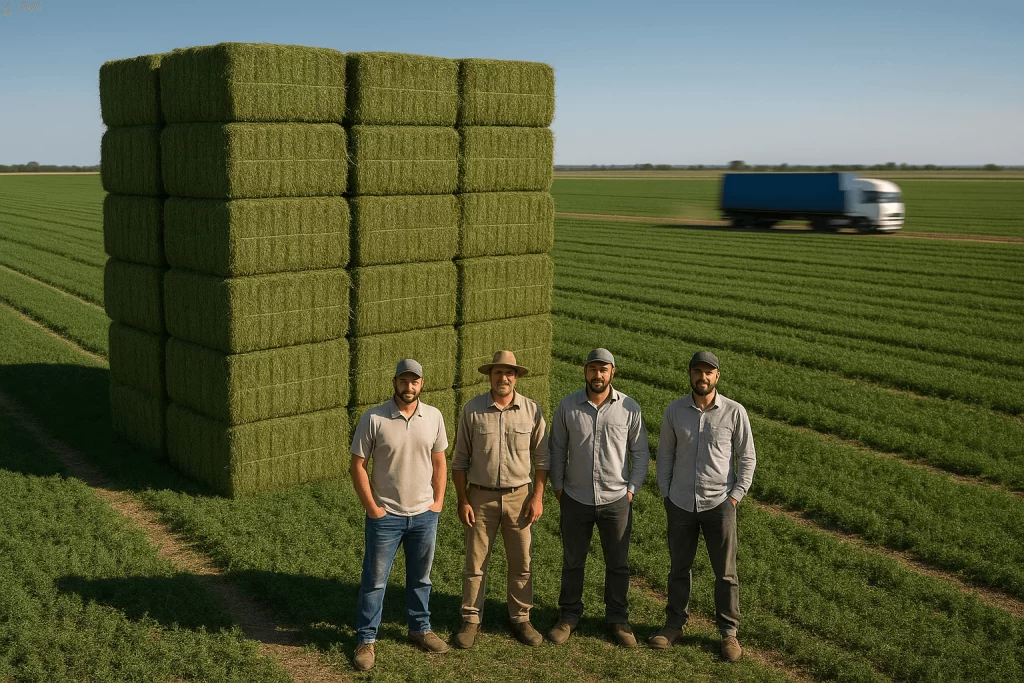
In Mendoza, five producers formed a cooperative to buy a full set of machinery: mower, rake, and baler. By the third season, they had recovered their investment and started offering services to others. Mechanized alfalfa production became a second business line.
This shows that with planning, professionalism, and long-term vision, even structural challenges can become growth opportunities.
The Role of Training in Agricultural Technology
Buying machines isn’t enough—you need to know how to use them
One common mistake is investing in state-of-the-art equipment without training the operators. New technologies require technical knowledge, precision settings, and continuous monitoring.
For example, cutting alfalfa with modern mowers depends on plant moisture, speed, and height. Using these machines incorrectly can be worse than not having them at all.
Rural technical training programs
Municipalities, agricultural schools, and machinery brands now offer free workshops on alfalfa equipment use and maintenance. Attending these sessions improves performance, reduces breakdowns, and extends equipment lifespan.
Training young operators in rural areas also addresses the labor shortage in agriculture, creating a positive cycle for the entire sector.
Toward More Competitive Alfalfa: Challenges and Opportunities
Combining technology with commercial planning
The future of mechanized alfalfa production lies in combining technology, climate awareness, and market needs. It’s not just about owning equipment—it’s about planning every step based on data: soil, moisture, yield, and buyer requirements.
The producer who adopts modern tools can adapt faster to change, optimize strategy, and remain competitive in volatile markets.
Turning adversity into advantage
The lack of modern machinery in alfalfa production isn’t a dead end—it’s a starting point. With creativity, strategic partnerships, smart financing, and access to training, many producers are transforming their fields and tapping into previously unreachable markets.
This isn’t just about producing more—it’s about producing better. And today, that’s more achievable than ever.
Conclusion
The lack of modern machinery in alfalfa production doesn’t have to hinder the sector’s growth. With clear information, smart decisions, and a collaborative mindset, producers can address this challenge and turn it into a concrete opportunity.
Argentine alfalfa has the potential to lead in high-end markets, but success requires quality, consistency, and professionalism. And it all starts with taking the first step toward efficient, modern, and sustainable production.