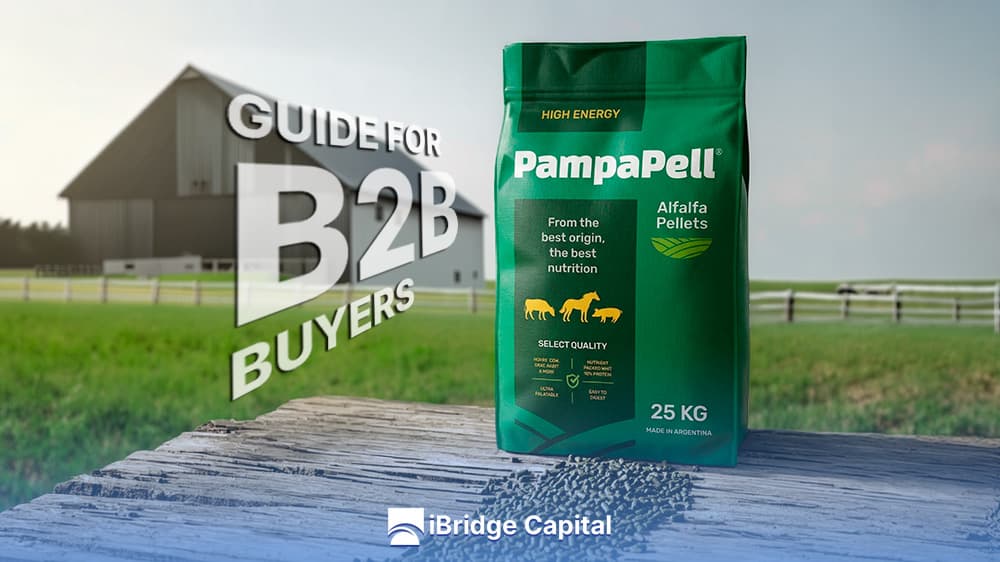
When a B2B buyer starts evaluating an alfalfa pellet operation from Argentina, the conversation almost always begins with the same question: what is the FOB price per ton of bulk alfalfa pellets? And that makes perfect sense. Price is usually the entry point into the commercial discussion.
That said, in our experience at PampaPell, the real issue is rarely solved with a single number. What we see time and again is that many buyers arrive with a very specific need, but without a clear understanding of how an operation from Argentina is structured, what an FOB quote actually includes, what documents they should ask for, and what roadblocks may appear at the beginning. That is where a quote alone falls short.
That is exactly why we wanted to put this guide together. Not to overcomplicate the topic or fill a simple question with unnecessary jargon, but to give buyers a useful reference point and, most importantly, context. Because a sound purchasing decision does not depend only on the value per ton. It also depends on understanding product quality, format, logistics, shipping point, and the bureaucracy that comes with any export operation.
If you are comparing suppliers and want to better understand how an offer from Argentina is usually structured, we recommend also checking our alfalfa pellets for animal nutrition page, where we explain the product from both a commercial and operational perspective.
What Is the FOB Price per Ton of Bulk Alfalfa Pellets?
The most honest answer is this: there is no single universal FOB price for bulk alfalfa pellets. What exists instead is a range that moves depending on quality, volume, port, availability, and the specific terms of the operation.
One of the most common mistakes we see is comparing prices that look equivalent but are not. Sometimes one supplier is talking about a plant-level reference value, another is quoting bagged product, another is quoting big bags, and another is quoting FOB port. All of that changes how the number should be interpreted. That is why, when someone searches for “FOB price per ton,” the first thing they should confirm is whether all suppliers are actually quoting under the same logic.
At PampaPell, we understand that a B2B buyer does not want to waste time decoding unclear quotes. They want to know what they are looking at and what they should ask before moving forward. That point matters because the lowest price is not always the best purchase if hidden costs, delays, or quality differences appear later in the process.
The market is not static either. Prices may shift due to seasonality, raw material availability, international demand, inland logistics costs, and port conditions. That is why the best practice is not to treat “today’s price” as a permanent truth, but rather to request a quote with a clear date, specifications, and commercial terms.
If you are still in the early comparison stage, it is worth reviewing our alfalfa pellet export offer, because that is where the conversation stops being just about “how much it costs” and starts becoming about “what exactly am I buying?”
What FOB Really Means in an Alfalfa Pellet Operation
FOB is one of those terms that seems simple until you get into the details. In theory, it means the seller delivers the goods on board at the agreed shipping port, and from that point on certain costs and risks shift to the buyer. In practice, what matters is not memorizing the textbook definition, but understanding how that translates into a real alfalfa pellet transaction.
When we talk about the FOB price of bulk alfalfa pellets, we are talking about a value tied to a specific shipping condition. That means you should not automatically assume it includes every prior or complementary cost. That is why, before comparing two FOB quotes, it is important to check what each supplier says about conditioning, loading, documentation, timelines, and the exact delivery point.
This is where many new buyers slow down, and understandably so. At PampaPell, we see it often: the challenge is not only negotiating the price, but understanding which part of the process is already covered in the offer and which part still needs to be organized. When a buyer enters the Argentine market for the first time, the biggest friction tends to appear at the beginning of the procedure, not at the end.
That is why a serious quote should help answer questions such as: which port is being considered, what product format is being quoted, what technical specifications are being used as the basis, how long the offer remains valid, and what commercial documentation accompanies the transaction. Without that, the FOB value loses clarity.
If your goal is to move from a price inquiry to a more concrete operation, you can also rely on our alfalfa pellet sales page, where we approach the product from a more commercial angle.
What Factors Affect the Price of Bulk Alfalfa Pellets?
This is the part that truly defines a negotiation. The FOB price does not move randomly. It changes because there are very real variables behind it that shape both perceived value and operating cost.
The first is pellet quality. A product with stronger protein, fiber, moisture, and consistency parameters is not the same as a more basic offer. In a B2B market, those differences are not cosmetic. They directly affect the purchasing decision and the negotiated price.
The second is volume. The more defined and scalable the operation is, the more commercial sense it makes to optimize price, logistics, and planning. A vague inquiry rarely gets the best conditions. A clear requirement with destination, expected volume, and approximate timing changes the conversation entirely.
The third is logistics. In Argentina, this matters more than many buyers initially expect. Distance to port, cargo availability, shipping windows, documentation coordination, and administrative timing can all push a quote up or down. That is why we place so much emphasis on operational context: not because we want to complicate the purchase, but because ignoring it often turns out to be more expensive.
The commercial format also matters. Bulk, big bag, and bagged product do not mean the same thing in terms of cost or handling. A buyer who looks only at the price per ton, without checking the format, risks comparing apples to oranges.
For anyone just beginning to map suppliers, our recommendation is simple: ask for the quote together with a clear description of the product and delivery structure. Along those lines, our PampaPell alfalfa pellet page can serve as a useful reference for understanding which variables should be on the table from the very first exchange.
The Difference Between Bulk, Big Bag, and Bagged Alfalfa Pellets
At first glance, this may seem like a minor distinction. It is not. The format affects cost, handling, storage, operational speed, and in many cases the overall convenience of the purchase.
Bulk is usually the option most aligned with an industrial or larger-scale approach. It makes sense when the buyer already has reception, internal handling, and traceability systems in place. In terms of efficiency, it can be very attractive, but it also requires greater coordination.
Big bag often works as a middle-ground solution. It makes handling more organized, supports certain logistics schemes, and may help when the buyer is not equipped to receive everything in bulk. Still, this format also adds its own cost and handling considerations.
Bagged product, on the other hand, may be useful in other commercial contexts, although it will not always be the best option for a B2B purchase focused on scale or export.
At PampaPell, we prefer not to present these formats as if one were “the best” in every case. The right question is not which one is cheapest in theory, but which one is more suitable for the buyer’s real operation. Sometimes the apparent savings per ton disappear once unloading, storage, or internal distribution become more difficult.
How a Purchase of Alfalfa Pellets from Argentina Usually Begins
This is probably the most useful part of the article for a brand like PampaPell, because this is exactly where we can provide real value.
When a B2B buyer looks at Argentina for the first time, the main difficulty is rarely finding a price list. The real difficulty is understanding how to get started properly. What to ask for. Who to ask. How to structure the conversation. What signs indicate that they are dealing with a serious supplier.
Our experience is very clear: uncertainty shows up at the beginning. And the more unclear that beginning is, the slower and weaker the operation tends to become.
Ideally, the first quote request should already include some basic information: exact product, desired format, estimated volume, destination, whether the need is for ongoing supply or a spot purchase, approximate timing, and any relevant technical requirements. That helps turn an open-ended inquiry into a useful commercial conversation.
Then comes another important layer: making sure the supplier responds not only with a number, but with context. In the way we work, a quote should guide, not confuse. It should help the buyer understand what they are receiving, what the next steps are, and which issues still need to be defined in order to move forward seriously.
That is why, if someone reaches out to PampaPell looking for a number, our goal is not to stop the conversation at that number. Our goal is to support the decision-making process. That is precisely the logic behind our commercial alfalfa pellet solution: combining product with operational clarity.
Bureaucracy and Documentation: What a B2B Buyer Should Expect
This is one of the strongest differentiators of this article, and also one of the least explained topics by competitors.
Yes, bureaucracy matters. And it matters a lot. Not because Argentina is an impossible market, but because for a first-time buyer there are procedures, documents, and timelines that are not always obvious from the outside. Ignoring that can make what looked like a simple operation turn into a slow or confusing one.
At PampaPell, we understand that this is one of the main sources of anxiety, especially when the buyer is already close to making a decision and does not want unexpected friction. That is why we insist on something very concrete: the process needs to be explained from the very first contact.
There is no need to turn this page into a full customs manual. But it does make sense to state clearly that a well-structured B2B purchase requires organized documentation, precise commercial definitions, and strong coordination between the parties involved. When that is communicated well from the start, the perception of risk drops significantly.
In our experience, Argentine bureaucracy creates more problems because of poor explanation than because of pure complexity. When the buyer understands the general roadmap of the process, the conversation changes. They no longer feel like they are buying blindly. Instead, they feel they are moving forward within a more predictable framework.
How to Compare Quotes from Different Suppliers Without Making Mistakes
Comparing quotes should not feel like guesswork, but sometimes it does. The most common mistake is focusing only on the final price per ton and ignoring everything else. The second mistake is assuming that all offers refer to the same product, the same format, and the same commercial condition.
A useful comparison should look at, at minimum, these points: product specifications, format, delivery condition, validity of the offer, volume considered, estimated timing, and degree of commercial clarity. A supplier who sends only a number may seem faster, but that does not necessarily mean they are helping the buyer more effectively.
At PampaPell, we believe that a serious quote should build confidence before the sale is closed. And that confidence is built through clear information, realistic expectations, and commercial language that does not force the buyer to interpret too much on their own.
When comparing suppliers, it also helps to evaluate whether the brand demonstrates a real understanding of the buyer’s business. Selling a commodity in a generic way is not the same as supporting an operation in which initial clarity affects the entire chain that follows.
If you want to explore that approach further, you can visit our commercial Argentine alfalfa pellet page, where we work precisely at that intersection of product, context, and practical value.
Conclusion
The search for the FOB price per ton of bulk alfalfa pellets may look like it is asking for a single number, but in reality it opens up a much broader conversation. What a B2B buyer truly needs is not just a number. They need to understand what that number represents, which variables influence it, and how a serious purchase from Argentina actually begins.
That is exactly why, at PampaPell, we want to build informative content from day one. We are a new brand, yes, but that is precisely why we want to enter the market by creating real value. Not only by presenting a product, but by helping buyers gain more clarity, more context, and better tools for making decisions.
In the end, a strong operation does not begin with an isolated quote. It begins with a well-structured conversation, useful information, clear expectations, and a supplier capable of explaining the process without overwhelming the client.
If you are evaluating a purchase and want to move from initial uncertainty to a more concrete commercial conversation, we invite you to learn more about our PampaPell alfalfa pellet offering.
FAQs
Does the FOB price include all costs?
Not necessarily. That is exactly why it is important to ask for a quote that clearly and specifically defines the commercial scope.
Is it better to buy in bulk or in big bags?
That depends on the type of operation, the volume, and how the product will be received and handled at destination.
Why can two suppliers give very different prices?
Because they may be quoting different quality levels, formats, volumes, or operating conditions.
What should I ask for in an initial inquiry?
Exact product, format, estimated volume, destination, timing, and basic technical requirements. The clearer the starting point, the better the quote.
What value does a new brand like PampaPell bring if it is just entering the market?
Precisely a focus on clarity. We want buyers to better understand the process so they do not have to make important decisions with incomplete information.