Alfalfa is a very delicate plant to grow and dry, since in humid climates it can generate mold or excess moisture inside, diminishing its benefits and deteriorating quickly, becoming a big problem for all livestock farmers.
In order to solve these problems, producers must dry the forage quickly, removing as much moisture as possible.
On the other hand, dry and hot climates also represent a great challenge for producers, since alfalfa can dry excessively, losing vitamins and carotenes necessary for the balanced feeding of animals.
For this reason, several producers and ranchers set out to design a system to dry alfalfa correctly, regardless of the place or time of the year. Below, you will find all the information you need to know about this curious system.
Let’s talk about CHINOOK

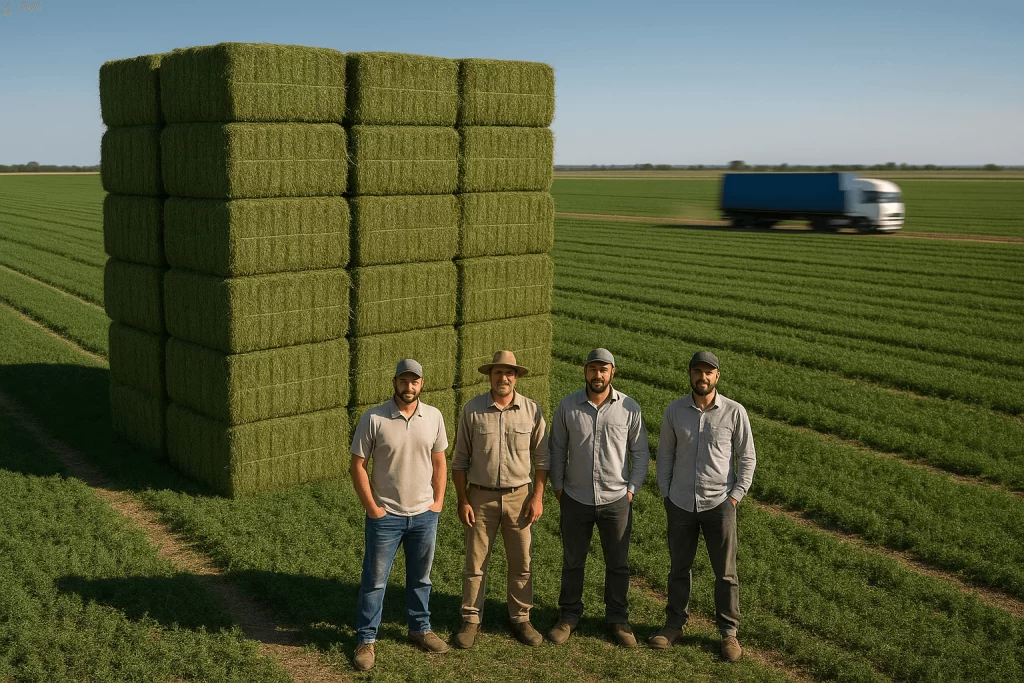
Chinook was founded by Cris Martin and his partners, as a specialized and reliable company in the search for solutions to problems related to alfalfa cultivation. Being themselves hay producers, who were in charge of identifying the problems and offering the best solutions.
An excellent example of the solutions that Chinook presents to its customers, is that it has a unique drying system in the world, which has a system with 120 nozzles, designed to push the air from above and below at the same time, obtaining a better distribution of air during the drying process, being uniform and more efficient.
Who is Chris Martin
Chris Martin is an agricultural producer, especially of alfalfa, who lives daily with different problems related to this product, losing large amounts of it because of mold and crop deterioration, reducing the quality of alfalfa and generating large economic losses.
It was then that he decided to meet with different people specialized in the field, in order to find the best solution to these problems.
Thus, Chris Martin and his business partners set about the task of creating a device for drying alfalfa, which bears the name of Chinook Systems. It is designed to considerably increase the nutritional values and quality of the hay, increase productivity and reduce the climatic risks that affect crops.
Main features

The main functionalities of the Chinook system focus on three fundamental aspects:
- Maximize quality: Chinook offers to maintain 85% to 90% of your harvest, increasing the quality of the hay from 15% to 20%, compared to other traditional methods that help drying this product.
- Increase productivity: Unlike these options on the market, Chinook allows you to harvest for more days, regardless of whether it is a very dry or wet season. In this way, hay can be harvested with more than 19% moisture, being dried to obtain a 1.5% increase in the nutritional values of the product, especially in the product’s protein.
- Reduction of losses: for many, this is one of the most important functions offered by this system, since it minimizes dust, mold and deterioration of the hay to the maximum.
How does the performance of this system increase?
One of the most interesting aspects of the Chinook system is the opportunity to grow alfalfa longer, regardless of the number of hours or the season in which the process is carried out, since a crop with 20% moisture can be processed and dried with the help of the system.
In this way, the product can increase more than 1.5% of the protein it normally has, offering more nutrients to the animals that consume it.
Main Features

- Diverts heat sources to individual bales.
- Can process 3×3 or even 3×4 bales.
- Drying in less time and with greater uniformity, due to the 120 points that the system has.
- Decreases 10 points of humidity in only 15 minutes (i.e. a 20% humidity bale is brought down to 10% humidity in 12-15 minutes).
- It is powered by a GENSET all-electric motor as well as mains power.
- It is designed to subdivide or add other units if needed.
Frequently Asked Questions?
- How big do bales have to be to be processed by the Chinook System?
This system works with 1.20 x 90 bales or Bale Baron bundles.
- Is the Chinook System better than traditional sun drying?
Unlike the traditional method, the Chinook system offers many nutritional and production benefits and eliminates the climatic risks that alfalfa can experience, such as the possibility of rapid deterioration or mold.
- Does the Chinook System offer benefits in dry or hot locations?
This drying system offers the possibility of being able to harvest alfalfa in any season and time of the day, being able to control the problems generated by dust in dry climates or excess humidity in rainy seasons.
- Where can the Chinook System be installed?
It can be located inside a shed or in any building with adequate dimensions for the dryer. It also has the option of being installed in the field even though it is not mobile, being able to work with a GENSET generator.
- Can the functionality of the system be increased?
Yes, in case your production expands or you have other needs, the system has the option to have other units added to meet the needs you may have.
Conclusion
Unfortunately, moisture negatively affects alfalfa production and drying, which can generate large losses for producers.
This is why the Chinook system represents a unique opportunity to quickly solve all the problems that alfalfa can experience due to excess moisture.
We invite you to contact our Chinook representatives in Latin America to ask any questions you may have about the system.