Exporting alfalfa from Argentina has become a strategic opportunity for local producers. Countries such as Saudi Arabia, China, Chile, United Arab Emiratesand other Southeast Asian destinations have increased their demand for vegetables of alfalfa, driving the country to position itself as a reliable player in the global market high-quality forage.
But to achieve successful insertion and maintain competitiveness in demanding markets, it is essential to correctly understand and apply the quality standards in alfalfa, both from a product perspective and from the logistics, documentation, and health processes. In this article, we explain everything you need to know to ensure compliance with these requirements and deliver your mega-bales to their destination without problems.
International panorama: Why is the world seeking Argentine alfalfa?
The global demand for alfalfa grows year after year. The increase in beef and dairy production, especially in arid countries with low capacity for fodder cultivation, has generated a strong dependence on imports of alfalfa for export.
Argentina has unique advantages: large expanses of fertile land, temperate climate, good levels of mechanization and access to strategic logistics ports like that ofRosario, which facilitates the exit ofAlfalfa in mega-bales with export quality to multiple destinations.
What factors determine the quality of exported alfalfa?
The quality standards in alfalfaThey are defined by physical, nutritional, and health parameters that ensure the forage meets the purchasing country’s expectations. Among the aspects most valued by importers are:
Nutritional content
An export-quality alfalfaIt should contain high levels of crude protein (minimum 16%), digestible fiber, essential minerals (calcium, magnesium, phosphorus), and low moisture content. Buyers also value a low lignin content, as it improves forage digestibility for livestock.
Leaf/stem ratio and color
The ideal leaf-stem ratio is greater than 50%, since the leaves concentrate most of the nutrients.deep green colorWithout dark or brown spots is a sign of good preservation and drying. Visual appearance strongly influences the perception of quality.
Humidity and health
The moisture requirements for exporting alfalfaThey range between 10% and 14%. Higher levels increase the risk of fermentation, mold, and rejection at destination. Furthermore, a total absence of pests, fungi, or contaminants is required.
Production and harvest: the origin of exportable alfalfa
To comply with the quality requirements for export alfalfa, the work starts long before packaging.alfalfa production in Argentina intended for export requires comprehensive planning from planting.
Alfalfa varieties adapted to export
The use of alfalfa varieties for exportIt’s key. The most popular varieties are those with high regrowth, persistence, and adaptation to frequent pruning, such as WL656, Monarca SP INTA, or Luján INTA. These varieties guarantee better results in yield and quality.
Good agricultural practices
From irrigation management to the perfect harvest time, every detail influences the final quality of the mega-bale. Harvesting should be done before flowering, when the plant offers the greatest nutritional balance and digestibility.
Drying and post-harvest handling
Efficient drying, whether under shade or in windrow systems, reduces the risk of leaf loss. Avoiding exposure to rain and controlling humidity before packing are critical steps in meeting the quality standards in alfalfa.
Compaction: How mega bales are prepared for export
The transformation of alfalfa intocompacted mega balesIt is one of the most sensitive links in the process. Buyers demand a homogeneous, firm product with a stable shape and uniform density.
What is a mega bale of alfalfa?
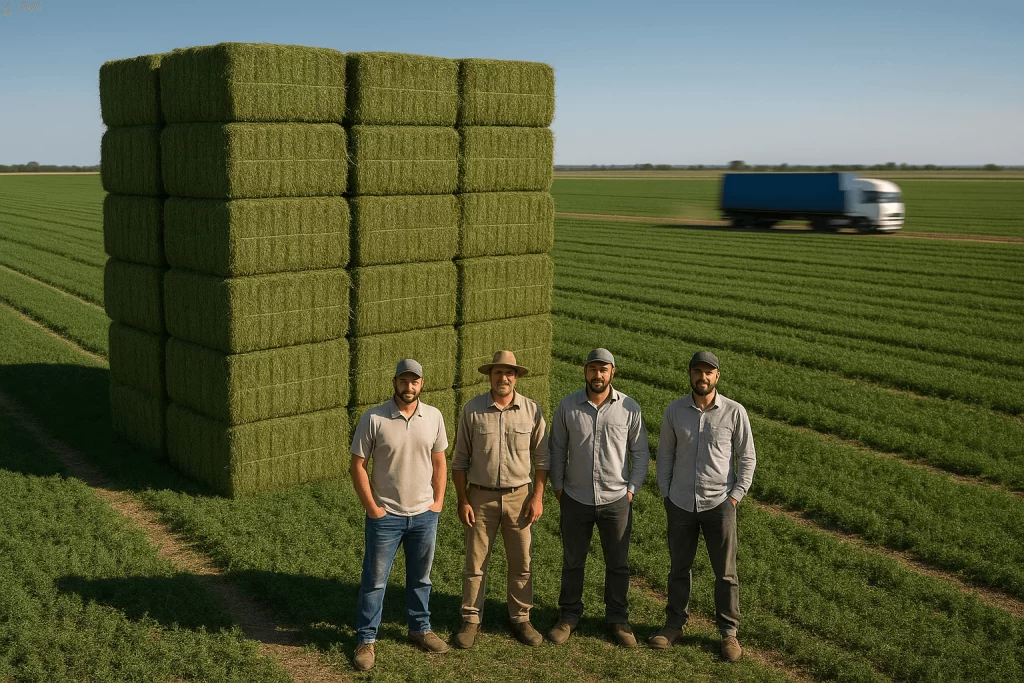
It is a pressed fodder unit weighing approximately 450 to 550 kg, the size of which is optimized for easy transport in maritime containers.compaction of alfalfa for export must maintain the integrity of the leaves without crumbling.
Compaction technology
The use of double-piston balers, closed chambers, and plastic wrapping systems allows for uniform density and protection of bales from the elements during storage or transport. The correct conservation of recompacted alfalfa is essential.
Certifications, inspections and phytosanitary requirements
The phytosanitary requirements for exporting alfalfa vary depending on the destination. However, all countries require official health certification, generally issued by theSENASA(National Service of Health and Agri-Food Quality).
SENASA: the first filter for export
SENASA verifies that the establishment is registered as a producer-exporter, that the alfalfa comes from a batch free of quarantine pests, and that the product is free of unauthorized chemical residues.
Certification of origin and traceability
Several countries ask for a certificate of origin of alfalfa, in addition to traceability tests indicating the batch, harvest date, sanitary treatment received and packaging location.
Specific requirements according to destination
Exporting alfalfa to China, for example, requires pesticide residue testing.Exporting alfalfa to Saudi ArabiaIt demands traceability and compliance with its halal regulations. It’s key to study each country’s protocols before starting the process.
Customs documentation and export procedures
To make an export of alfalfa from Argentina, it is necessary to gather the following documentation:
- commercial invoice
- SENASA phytosanitary certificate
- Certificate of origin
- Packing list
- Customs declaration
- Boarding authorization
- Letter of credit or payment agreement
The process is carried out through a customs broker. Most shipments are made from theport of Rosario, given its proximity to the main production areas.
Logistics: How to transport alfalfa without losing quality
The transport of megaloads of alfalfa toward its destination is another critical part of the process. Each stage can affect the fulfillment of the quality standards in alfalfa if precautions are not taken.
Internal transport
Cargo is usually transported by truck to logistics centers or ports. It’s essential to avoid breakage, cross-contamination, or exposure to the elements.
Maritime transport
The maritime containers for exporting alfalfaThey must be ventilated, clean, and suitable for agricultural cargo. In some cases, plastic liners or special pallets are used to ensure better support.
How to improve export competitiveness
Reduce logistics costs
The alfalfa export costs are a common barrier. Vertical integration, the use of nearby logistics centers, and document efficiency help reduce time and costs.
Professionalization of the process
Investing in monitoring technologies, quality controls, in-house laboratories, and technical training is key. Every error at origin can lead to costly rejections at destination.
Association between producers
Cooperatives or associations allow for pooling volumes, standardizing processes, and negotiating better prices with exporters. This is especially useful for small and medium-sized businesses in the interior of the country.
Conclusion
Exporting alfalfa is more than just packing and shipping. It’s about align with quality standards in alfalfa that the international market demands. From the genetics of the seed to the moment the container arrives at its destination, every step counts.
Argentine producers who manage to professionalize their production chain, document every movement, consolidate with technology, and adapt to international protocols, don’t just export a product: they export trust. And that trust is the most valuable asset in global trade.
If you’re taking your first steps in exporting or want to improve your position as a reliable supplier, focus on the essentials:quality, traceability, compliance and efficiency.