Alfalfa hay quality for export: requirements and factors that close trade doors
The international alfalfa hay market is highly demanding and competitive. For producers, the prospect of exporting bales to destinations like Southeast Asia or the Middle East represents a dream of profitability.
However, there is a harsh and recurring reality: a rejected shipment or a drastically reduced selling price. This doesn’t happen due to logistical failures or customs problems; the main cause is…alfalfa hay quality for export.
When the load does not comply with the alfalfa quality standardsAt the prices set by the buyer, the hay becomes a “cargo that never arrives” at the agreed-upon price. The export value of alfalfa hay is directly and inflexibly tied to its nutritional value and physical appearance.
International standards: What do the markets of Asia and the Middle East demand?
The main importing markets, particularly those with large dairy and livestock industries (such as China, Japan, the United Arab Emirates, and Saudi Arabia), have very clear specifications. These countries buy alfalfa hay as a concentrated source of nutrition and do not accept low-performing substitutes.
Neutral detergent fiber (NDF) and acid detergent fiber (ADF) requirements.
Hay quality is essentially measured by its digestibility. Alfalfa hay is valued for its high content of available nutrients, which is measured through fiber analysis. Neutral Detergent Fiber (NDF) reflects the amount of cell wall and is inversely related to the animal’s intake.
For high-end export markets, low values are preferred. For example, many importers require NDF below 40% and ADF below 30% to classify hay in the categoryPremium. The Nutritional analysis of alfalfa hayThey need to be clear about it.
Minimum crude protein percentage for Premium grades.
The Minimum raw protein for premium heno It is the most publicized parameter. Although protein is only one component of total nutrition, it serves as a primary quality indicator. Alfalfa hay, by its very nature, should be high in protein.
| Quality Category | Minimum Crude Protein (CP) | Typical Use |
| Supreme | >22 % | High-performance nutrition, export |
| Premium | 18-20 % | Exporting and demanding markets |
| Half | 16-18 % | Local market, supplement |
Any value below this range, especially 18%, automatically reduces the product’s profitability. It is important for the producer to know the properties of high-quality alfalfaThey are linked to impeccable agricultural management.
Color, smell and texture parameters in hay.
Although they are sensory metrics, color, aroma, and texture directly influence palatability and, therefore, the final price. A bright green color is synonymous with proper drying and minimal sun damage, which translates to high quality.quality.
Hay that is brown or yellowish (discoloration from sun or rain) or that smells musty, rancid, or fermented (due to high humidity) may be grounds for total rejection. The buyer knows.How does the color of hay affect its price?.
The Forage Value Index (FVI) and Relative Quality (RQI): Key Measures
In export circles, simply talking about crude protein is insufficient. Serious buyers rely on composite indices that synthesize information on fiber and digestibility.
How to calculate forage value and its meaning.
Forage Value (FV) is a tool that combines the potential intake of forage (based on NDF) and its digestibility (based on ADF). The higher the FV, the greater the nutritional and economic value of the hay. Advanced producers use the formula ofHow to calculate the forage value index (FVI) in alfalfa to justify the higher price.
RFV Interpretation: Hay Classification.
The Relative Quality Factor (RQF) is the predominant metric in the US market and, by extension, in the international market. It answers the question:What is the relative quality factor (RQF) in alfalfa?.
The RFV is a unitless index that rates hay relative to standard quality alfalfa (whose RFV is 100). A load with an RFV above 170 is considered Super Premium, while one below 130 is not suitable for the most profitable export markets.
Relationship between digestibility, lignin and RFV.
The lignin in alfalfa hay and digestibilityThey have an inverse and critical relationship. Lignin is a fiber component that is not digestible by the animal, and its concentration increases with plant maturity. Hay cut late will have a high lignin content, low digestibility, and a poor fiber utilization rate (FVR), which explains one of the factors that affect hay quality.
This is one of the main reasons why the quality alfalfa leaf-stem ratioIt is crucial: the leaf contains most of the nutrients, and the stem, as it matures, increases its lignin content.
Humidity control: The risk of rejection due to mold and fermentation
Moisture management is where most shipments fail. A bale with inadequate moisture not only loses quality but also poses a phytosanitary and structural hazard.
Ideal moisture content for the exportable bale.
The ideal moisture content in alfalfa for safe storage and export is of10 % al 14 %This range minimizes microbial activity and the risk of spontaneous combustion (although the latter risk is greater in stored hay than in shipping containers).
Methods for measuring moisture in the field before baling.
Relying solely on tactile feedback is a mistake that costs thousands of dollars.technology for measuring moisture in hayModern (electronic bale gauges) are mandatory. These devices allow the producer to know for sure when the hay has reached equilibrium moisture.
Baling it when it is too wet is the main cause of [the problem].risks of fermentation in wet alfalfa hayand the formation of mold.
Phytosanitary risks associated with excess humidity.
Mold not only reduces the value of hay, but also produces mycotoxins, toxic substances that are dangerous for animals. Severe mold infestation is grounds for outright rejection, forcing the destruction or re-export of the shipment, generating freight, storage, and penalty costs that can exceed the initial value of the cargo.
Agronomic management: Factors that define quality from the field
Quality is built in the soil. Genetics, fertilization, and irrigation management are as vital as the harvesting process.Benefits of alfalfa compaction for exportThey can only be enjoyed if the raw material is premium.
Impact of the cutting time on the leaf-stem ratio.
The optimal harvest time is at the flower bud or pre-flowering stage. Harvesting at full bloom increases biomass yield but drastically reduces quality. Protein content decreases while fiber content increases.
This is the main concept to understand aboutHow does late cutting affect protein in alfalfa?A timely cut maximizes the quality alfalfa leaf-stem ratio ensuring that the majority of the bale consists of protein-rich leaves.
Influence of the pest or disease on the nutritional value of the hay.
Crop health is essential. Pests and diseases not only reduce production but also damage quality. An affected crop has yellowing or drooping leaves, which lowers the value of the hay, as the most nutritious part is lost.
The choice ofDisease-resistant alfalfa varieties for exportand the application of treatments to control insects in alfalfa hayare part of the good agricultural practices for premium hay.
Correct drying and curing process in rows.
Asdrying alfalfa for exportIt’s an art that requires precision. The goal is to dry the stem without over-drying the leaf. Drying should be quick, but not in direct sunlight to avoid oxidation and loss of carotenoids (which give the leaf its green color).
Uniform distribution of material in the row is vital. In areas with high rainfall or low solar radiation, some producers invest in theArtificial drying of alfalfa and natural drying to ensure uniformity and color.
Contaminants and quarantine pests: The phytosanitary barrier
Phytosanitary rejection is non-negotiable and is the direct cause of why a shipment can be blocked in port.
Identification of prohibited weeds and toxic plants.
of the main problems in alfalfa exportsIt’s weed contamination. Importing countries have very strict lists. Alfalfa hay must be as pure as possible. Which one?is the maximum percentage of weeds allowed in alfalfa hayIt varies, but 0% is ideal, and any noticeable presence can devalue or render the bale unusable.
Phytosanitary certification requirements (SENASA or equivalent bodies).
Compliance withSENASA standards for alfalfa export(or the phytosanitary authority of the country of origin) is mandatory. This includes inspecting the cargo to ensure it is free of live organisms.
The Phytosanitary certification protocol for alfalfa hay to ChinaIt is one of the most rigorous. Once the requirements are met, the certification is obtained.Phytosanitary certification of alfalfa hay that accompanies the documentation required to export forage.
Control of rodents and other physical contaminants in storage.
The Prevention of rodents and contaminants in balesIt should be a priority in thePost-harvest handling of alfalfa hayThe presence of any foreign material (plastic, metals, garbage, excrement) is a physical and biological contaminant that can lead to total rejection.
The storage methods for exportable alfalfaThey must be designed to protect the integrity of the pressed bales.
Compaction and presentation: How the bale affects logistics and price
The bale for export is not the same as the bale for local consumption. The bale is the packaging and must optimize logistical costs.
Advantages of mega bales and high-density baling.
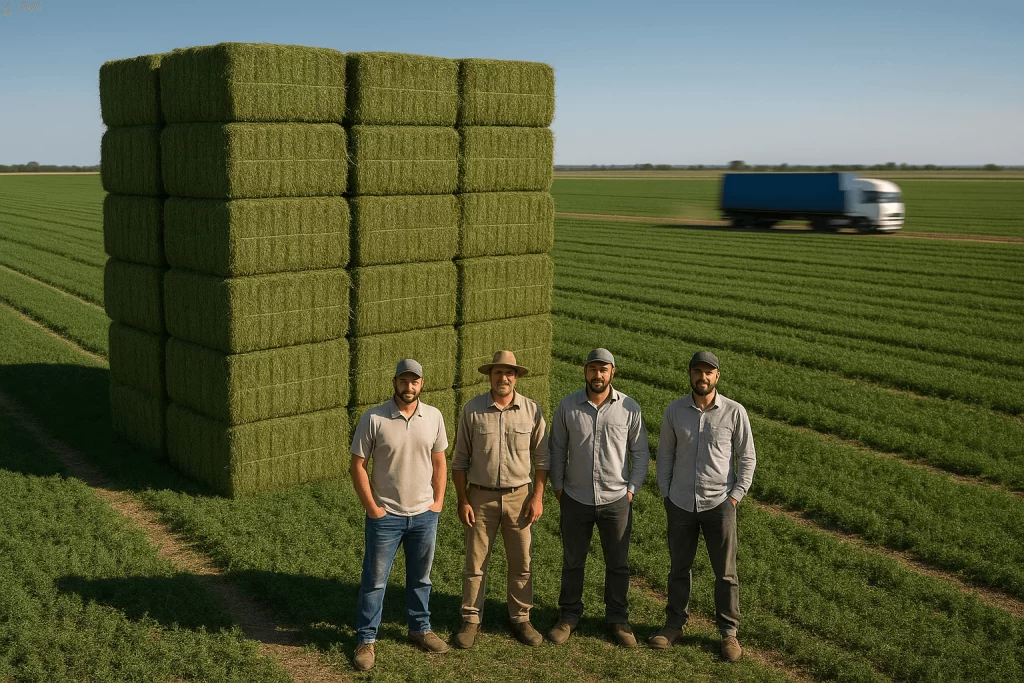
The export market operates with large volumes. Most transactions are carried out usingWhat are mega bales of alfalfa?(or large packages) and high-density balers. The goal is to load the maximum amount of product per container so that the hidden costs of low-quality alfalfa affect profitability as much.
For example, a 40-foot shipping container can hold between 20 and 25 tons of medium-density hay. With higher compaction (pressed to 160-180 kg/m³), more than 28 tons can be loaded. This reduces the freight cost per ton, making the export price more competitive.
Weight and size specifications for maritime transport.
The Types of alfalfa hay bales for transport.They must have standardized dimensions and weights so they can be loaded and unloaded mechanically and so that cargo counting is simple and accurate. The shape and quality of the strapping are key; a broken strap or a misshapen bale can cause handling problems.
Ultimately, it all comes down to profitability. The article’s title itself reflects a real economic problem. Low quality not only reduces the price but also eliminates the possibility of making a profit.
Loss of value due to discoloration or lack of uniformity.
It is estimated that the price difference between a hay that is intense green, uniform, and has high RFV (Supreme) and one that is yellowish, without uniformity (Medium), can be of20% to 40% per ton.
High-quality hay is sold by analysis (tested), while a low-quality one is sold by visual inspection (sightSelling by inspection means submitting to the buyer’s discretion and accepting large discounts. It’s the difference between a stable price and playing Russian roulette. Therefore, it’s essential to understand theImpact of hay quality on export price.
The opportunity cost of not reaching Supreme status.
Economic impact: the price difference between premium and low qualityThis is the reason for all the effort. The producers who control the value chain and consistently deliver top-quality haySupremeor higher not only get the best price, but also build long-term relationships with premium customers who are willing to pay the premium for guaranteed quality.
The trends in the international alfalfa hay marketThey show consistent growth in demand for superior quality. Invest in the category.SupremeIt is the only way to build a sustainable export business.
Conclusion
The path to exporting alfalfa hay is, above all, a commitment to excellence. It’s not just about harvesting large volumes, but about mastering every agronomic, technical, and logistical detail to ensure the product meets global standards.
If your goal is to access the most profitable markets and ensure that the export price of alfalfa hayReflect your effort; quality isn’t optional, it’s essential. Analyzing, measuring, and certifying your hay is the step that transforms a simple harvest into a global business opportunity.